The massive sums being spent on data center infrastructure reflect a surge in demand for AI, both to train frontier models, and to perform the inference operations which drive the outputs of agents such as ChatGPT and Claude.
AI data centers are made up of networks of processors and memory devices. Today, the majority of the links which connect computing systems are made of copper wires, in the form of backplanes and cables. But now data centers are faced with the challenge of massively increasing network bandwidth both within and between servers.
The traditional technical response has been to increase the frequency at which signals are transmitted over these copper-based networks. But this approach is becoming more difficult: energy per bit, heat generated and system complexity all increase as the operating frequency rises to ever more extreme highs. The industry is therefore looking for alternative solutions.
This is why ams OSRAM is developing an optical, microLED-based solution for high-bandwidth data transfer in AI data centers: The traditional approach to optical networking adopts a fast-and-narrow mode, which achieves high bandwidth by transmitting data at very high frequency through a single cable. The ams OSRAM solution takes a different approach, using a slow-and-wide architecture in which hundreds or thousands of microLED emitters operating in parallel replace a single high-speed, high-power laser transmitter.
Arrays of microLEDs and the technology for driving and controlling them are already in commercial use in ams OSRAM’s EVIYOS™ platform for automotive lighting. This proves that we have mastered the challenges of manufacturing and co-packaging powerful microLED emitters and digital control circuitry.
But both the microLEDs used in data communications, and the way to implement them, are different from those in automotive lighting. And today, network equipment manufacturers which want to innovate with microLEDs have limited evidence for the level of performance that such a system could achieve in the normal operating conditions of a data center.
Technical simulation models performance in real-world conditions
Now ams OSRAM has developed a way to meet the data center industry’s need for technical specifications for this new technology: we have built a simulation model which allows us to estimate the performance of a microLED-based communications link when exercised with real AI data flows.
The ams OSRAM system model includes time- and frequency-domain simulations as well as bit error rate simulations. It models the operation not only of the microLEDs, photodiodes, lenses, and the varieties of optical fiber through which signals pass, but also the transmit equalizer, driver, receive equalizer, and amplifier – in other words, the key elements of the electro-optical front end of an AI server’s optical data link.
The component-level models combine measured microLED characteristics with physics-based behavioral models of the remaining components: they allow us to take account of key electrical and optical parameters such as microLED radiation profile, photodiode responsivity, and chromatic and modal fiber dispersion. The simulation model then produces outputs for key performance indicators (KPIs) such as bit error rate, energy per bit, and signal-to-noise ratio.
Each of these KPIs can be calculated for operating conditions and component choices specified by the user: change the length of the fiber or the type of fiber used, and the model shows how the KPIs change. The model also allows the user to see how performance and energy consumption change when the model is optimized to a specific bit error rate requirement.
The reverse is also true: the model can be used to derive specific component specifications in a link optimized for a certain combination of system requirements.
The model is being extended to include electrical and optical crosstalk between the tightly arranged microLEDs and photodiodes, as well as the thermal behavior of the packaged device.
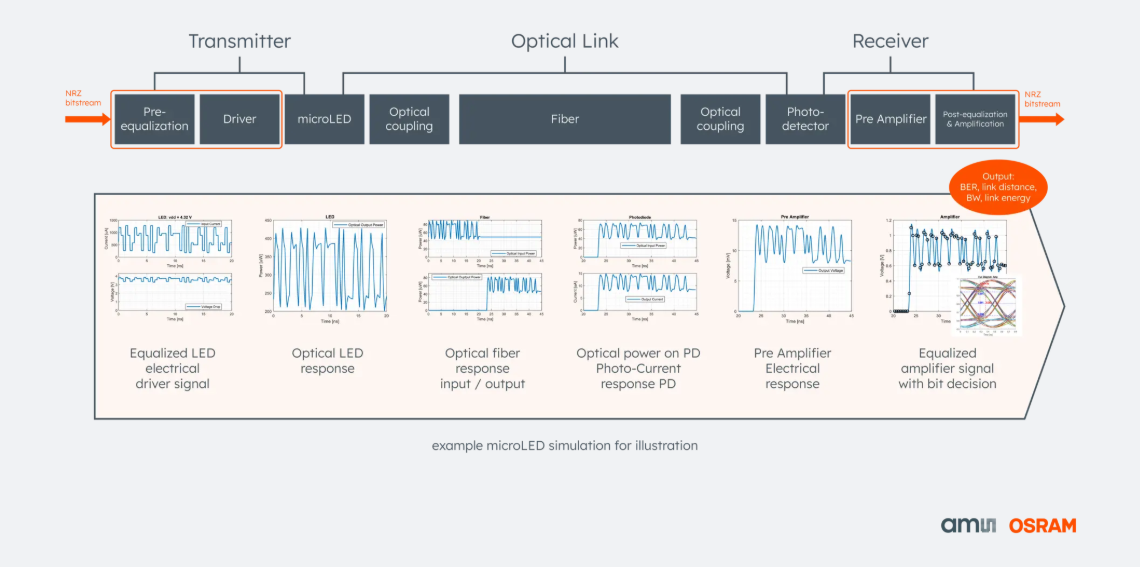
What does this mean for potential partners and customers such as network equipment manufacturers? They can now take advantage of sound modeling of the system link before they commit funds to designing and making the first hardware implementation of a microLED-based data interconnect.
With this simulation model, partners can define precisely the requirements for the separate components of the data link, and work out whether the provision of the required components and the design of the system are feasible.
We invite potential customers to contact ams OSRAM today to learn more about the simulation model, and to run simulations with the configuration parameters of their choice.
(Photo credit: ams OSRAM)
TrendForce 2026 Infrared Sensing Application Market and Branding Strategies
Release: 01 January 2026
Format: PDF / EXCEL
Language: Traditional Chinese / English
Page: 168
TrendForce 2026 Micro LED Display and Non-Display Application Market Analysis
Release: 30 September 2026
Format: PDF
Language: Traditional Chinese / English
|
If you would like to know more details , please contact: |
Disclaimers of Warranties
1. The website does not warrant the following:
1.1 The services from the website meets your requirement;
1.2 The accuracy, completeness, or timeliness of the service;
1.3 The accuracy, reliability of conclusions drawn from using the service;
1.4 The accuracy, completeness, or timeliness, or security of any information that you download from the website
2. The services provided by the website is intended for your reference only. The website shall be not be responsible for investment decisions, damages, or other losses resulting from use of the website or the information contained therein<
Proprietary Rights
You may not reproduce, modify, create derivative works from, display, perform, publish, distribute, disseminate, broadcast or circulate to any third party, any materials contained on the services without the express prior written consent of the website or its legal owner.
Trending Products

Video Conference Lighting Kit, Ring...
15W LED Video Light Kit
Desk Ring Light for Zoom Meetings &...
SAMHOUSING Ipad Tripod Stand, with ...
LISEN Tablet Stand
LanPavilion iPad Stand, Adjustable ...

DJI Osmo Mobile SE, 3-Axis Phone Gi...
2pcs Original Joystick Parts for Zh...
hohem iSteady M7 Gimbal